
'If Indian armed forces entered Pakistan and succeeded in inflicting major damage on the Pakistani army and occupied territory in the Pakistani heartland, there is reason to think the Pakistani military would use some nuclear weapons against the incoming Indian forces to compel India to stop.'

Moving ahead with their new mantra -- Chalein Saath Saath: Forward Together We Go -- Prime Minister Narendra Modi and United States President Barack Obama on Tuesday vowed to deepen cooperation in every sector for the benefit of global stability and people's livelihoods over the next ten years.
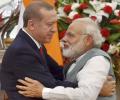
Turkish President Recep Tayyip Erdogan's has been trying to mollycoddle India with sweet nothings while having a very close relationship with Pakistan.

Scotland Yard said the incident is being treated as possible terror offence.

'Islamist terror groups have never been challenged ideologically. As long as their ideology survives, like cancer, these groups will sprout somewhere else, says Colonel Anil A Athale (retd).

'You can ascribe any ideology to him, and it will be equally right - or equally wrong.' 'Even though the comrades on the Left will never admit it, he seems as much Stalinist as capitalist.'

Vietnam is a key player in India's act east policy under Prime Minister Narendra Modi. From India's perspective, a strategic partnership with Vietnam will only deepen political, economic, and security ties and be a bulwark against China, say Melissa S Hersh and Dr Ajey Lele

Sparks flew in the Lok Sabha on Wednesday as the raging Jawaharlal Nehru University row and suicide of Dalit student Rohith Vemula was taken up for discussion, with opposition accusing the government of muzzling the voice of the youth and "mercilessly crushing" the principles of democracy.

Indian High Commissioner in Islamabad Gautam Bambawale met Pakistan Foreign Secretary Tehmina Janjua in connection with the case of Jadhav, who has been given death sentence by a Pakistani military court for alleged spying.

An attacker drove a car along a pavement in Westminster, stabbed a policeman and was shot dead by police in the grounds of Parliament.

'We use the word "historic" perhaps too much, but the prime minister's visit certainly was historic in so many ways.'
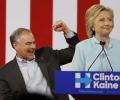
Rediff.com reproduces this 2014 interview with Tim Kaine where in he discusses the new opportunities to foster Indo-US trade and the improvement in ties.

Indian Americans speak up about the daunting challenges on the 16th anniversary of the tragedy.

'India and Indian Americans cannot rely on wishful thinking about the checks and balances in the US system to magically take care of the many dangerous things that Trump could do,' says Chicago-based writer Ram Kelkar.
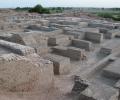
"South Asian studies" academics in the US would do well to introspect how they wittingly or unwittingly become part of Pakistan's proxy war in wielding influence over academics and policy, says Sankrant Sanu.
'Under Narendra Modi's leadership, we will be able to regain our rightful place in the community of nations,' veteran diplomat Hardeep Singh Puri, who joined the BJP on January 2, tells Rediff.com's Sheela Bhatt.
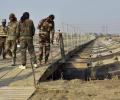
Many senior officers believe the chief should have taken a stronger stand against using army resources to help what one officer calls "a government-friendly godman".
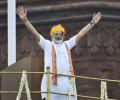
Following is the full text of Prime Minister Narendra Modi's address from the ramparts of the Red Fort on the 73rd Independence Day.

The decision to not attend the forum attended by 28 heads of state and 130 national delegations is a clear break from its usual policy of going along with the crowd.
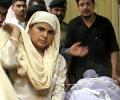
The damage done to India's intelligence agencies and its ability to undertake covert operations is irreparable, says senior BJP leader Arun Jaitley

India's breakthrough in countering a 'dirty bomb'.

The official twists and turns have raised questions on the government's credibility and its ability to pull the nation out of the demonetisation quagmire. To keep up with the new rules, the government has issued an updated FAQ on demonetisation.

The Security Council as it is today is unable to bring peace and security in the world and so there is reason for countries like India to become members of the Council, Ambassador Asoke Kumar Mukerji tells Sheela Bhatt/Rediff.com.

The BRICS summit made clear that China's support for Pakistan is unwavering. China will continue to pressure India to ease tensions with Pakistan and resolve the Kashmir dispute.
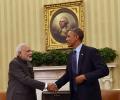
Furthering Indo-US cooperation on terrorism, Prime Minister Narendra Modi and President Barack Obama on Tuesday agreed to make "joint and concerted efforts" to dismantle safe havens for terror and criminal networks like Lashkar-e-Tayib, Jaish-e-Mohammad, Dawood-company, Al Qaeda and the Haqqani network.
Some members of the Obama administration have worried that Pakistan's heightened anxieties about India might lead Islamabad to take reckless measures, so they have wanted New Delhi to pursue more diplomatic engagement with Islamabad.

In a turnaround, Pakistan asked for "more evidence and information" from India on the Mumbai attack case and asserted that talks cannot take place without Kashmir being on the agenda, barely three days after the two countries agreed to re-engage.

Just because one can (so far) criticise the policies of the government, or expose a corruption scandal, or question bureaucrats, does not mean we have freedom of speech, says Sherna Gandhy.

'The category of crime and criminals called Maoist or Naxal or #UrbanNaxals is an illegitimate creation of right-wing propaganda media frenzy.' 'It is a fiction repugnant to the Constitution and the law of the land,' argue Vernon Gonsalves and Arun Ferreira.

'Mohammad Akhlaq's death isn't only about a Muslim being killed out of sheer communal bigotry, but also the denial of the Constitutional guarantees of "due process" under Article 21 and the freedom of choice,' says Shehzad Poonawalla, who has moved the National Commission for Minorities over the murder.
'The threat that India faces and the threat the United States faces is not just to the homeland, but to our people and to our institutions wherever they may be.' In an exclusive conversation with Aziz Haniffa/Rediff.com, US Assistant Secretary of State Nisha Desai Biswal outlines the importance of Prime Minister Modi's visit for America.

'The obsession of the Pakistan army with India leads to several destabilising things. Support for the Taliban in Afghanistan. Support for groups like the Lashkar-e-Tayiba, that have attacked India. Every time you get an attack like that there is a possibility of a war. And then the build up of the their nuclear arsenals. Chances of a nuclear weapon landing in the hands of a terrorist group, or a nuclear war breaking out, are tiny. But they are higher here than anywhere else in the world.'

Since multilateral trade creates a stable, peaceful world, normalisation of bilateral trade between India and Pakistan will start a series of peace building measures, especially along the bordering areas of both states which is the worst affected from the on-going conflict, say Riya Sinha and Shehzad Poonawalla.
'There is simply no evidence of any new or clear policy direction in internal security, and mounting evidence of policy incoherence.' 'Worse, the promise of giving the common man -- and, more importantly, woman -- a greater sense of security has been utterly belied. Indeed, with an escalation of communal posturing and rhetoric, there is a broader sense of uncertainty,' says Ajai Sahni.

'US counter-terrorism policy was encouraging and emboldening the Indians to deal with the problem of Pakistani-supported terrorism once and for all.' 'The US had been trying to browbeat Pakistan into doing what it wants, with very limited success.'

'Crafting a coherent, transparent and consistent policy vis-a-vis our neighbours, leave alone the rest of the world, is unlikely to be high on the priority list of the new Indian government, which will be sworn in before June,' says Ramananda Sengupta.

Council on Foreign Relations Senior Fellow Daniel Markey Tuesday said that the raising of the issue of American intervention in Jammu and Kashmir by visiting Pakistani Prime Minister Nawaz Sharif at the United States Institute of Peace in Washington was not 'especially constructive' and was motivated by political expediency.

'The summer of 1857 saw violence, perpetrated by the Indians and the Britons, on an unprecedented scale.' 'Never before and never after in the history of British rule in India was there violence at the level that 1857 witnessed.'

'Attempts at long-term rapprochement have been rather feeble from both sides. The primary cause of the lack of progress is that these efforts do not appear to have the support of the Pakistan army,' says Brigadier Gurmeet Kanwal (retd).
 © 2026 Rediff.com - Advertise with us - Disclaimer - Privacy Policy - Sitemap - Feedback - About us - Terms of use - Grievances